

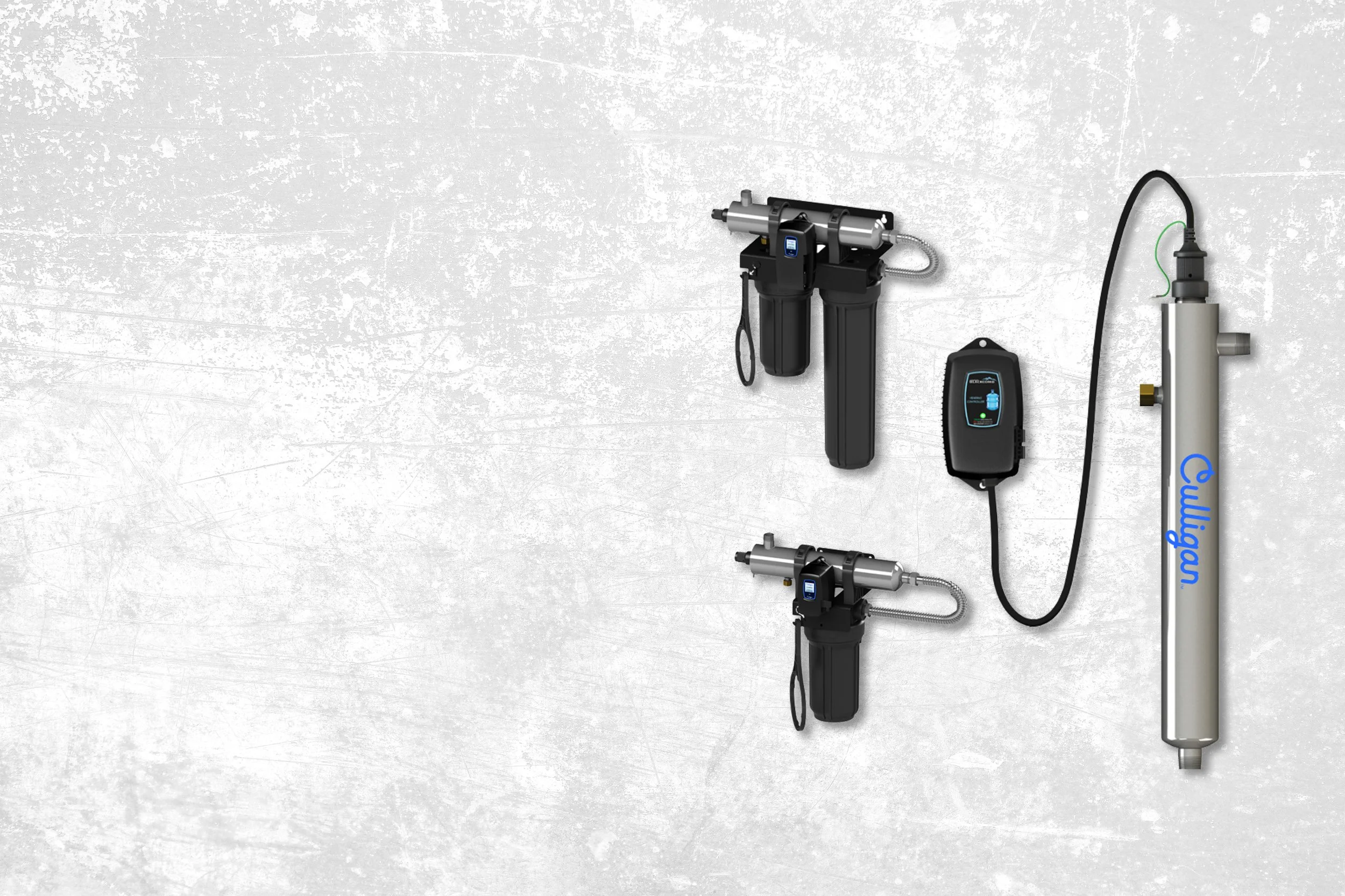
Why Culligan UV water disinfection system?
These systems are installed as the final stage in a home water treatment line to neutralize microorganisms like bacteria and viruses.
Why UV?
UV uses no chemicals and does not create any by-products or residuals
Energy efficient & environmentally friendly Prevents regrowth of viruses, bacteria and parasites
Does not add any taste or odor to the water 99.999% effective disinfection*
*Systems are proven by independent lab testing to show a 99.999% reduction (5-log) in E. Coli contamination and a 99% reduction (2.0 log) of the MS-2 coliphage challenge microorganism
UV Systems for Your Home
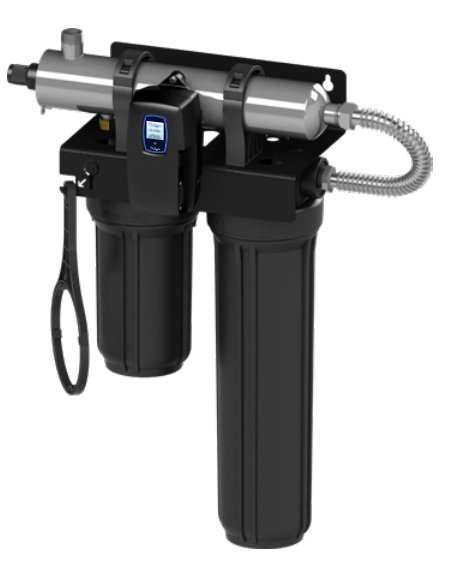
To ensure the right fit and performance, this product is professionally installed and not sold online. Estimated starting investment: $1933.00.
Contact Culligan of Fredericton for a custom quote tailored to your water and home.
We provide product solutions for whole home, light commercial, industrial and municipal applications.
UV uses no chemicals and does not create any by-products or residuals
Energy efficient & environmentally friendly
Prevents regrowth of viruses, bacteria and parasites
Does not add any taste or odor to the water
99.999% effective disinfection*
15 GPM 56.8 lpm 3.4 m³/hr
CL420HO UV Bulb, CQ420 Sleeve, 10" Sediment, 20" Carbon
Features
One-piece sump filter head for a leak resistant design
Pressure gauge ports for easy access, logging and maintenance
Universal mounting configuration for left or right access
Filter housing drain plug for easy draining and maintenance
316L stainless steel, axial flow reactors for corrosion resistance
Low pressure, coated, pre-heat UV lamps for consistent UV output throughout lamp life of 375 days
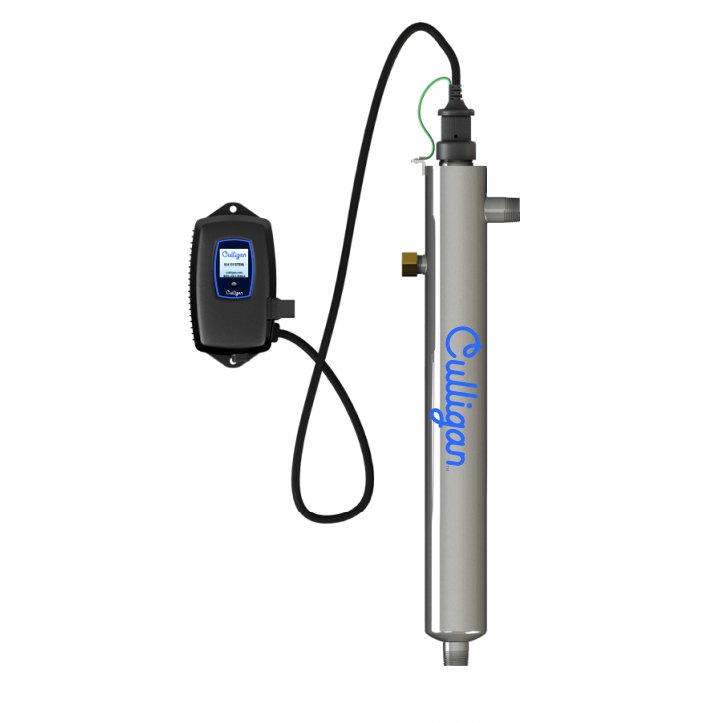
To ensure the right fit and performance, this product is professionally installed and not sold online. Estimated starting investment: $989.00.
Contact Culligan of Fredericton for a custom quote tailored to your water and home.
Treat your water with Culligan’s UVC LED water bottle. This easy to use, environmentally friendly bottle provides on-the-go water treatment, avoiding the use of added chemicals.
Sensor port for future upgradeability, doubles as visual glow plug
304 stainless steel, axial flow reactors for maximum efficiency
Mounts vertically or horizontally for maximum flexibility
IEP (infinite expandability port) for upgrades & options (CUV5/6)
Colour interface with diagnostics, warnings, and QR codes (CUV5/6)
Protect lamp sales with LIGHTLOCK™ technology (CUVH5/6)
Low pressure, coated, pre-heat UV lamps for consistent UV output throughout lamp life of 365 days (plus 10 days grace for replacement)
6 GPM 22.7 lpm 1.4 m³/hr
Bulb CL470 (annual replacement required)
Sleeve CQ470 (replaced every 2-3 years)
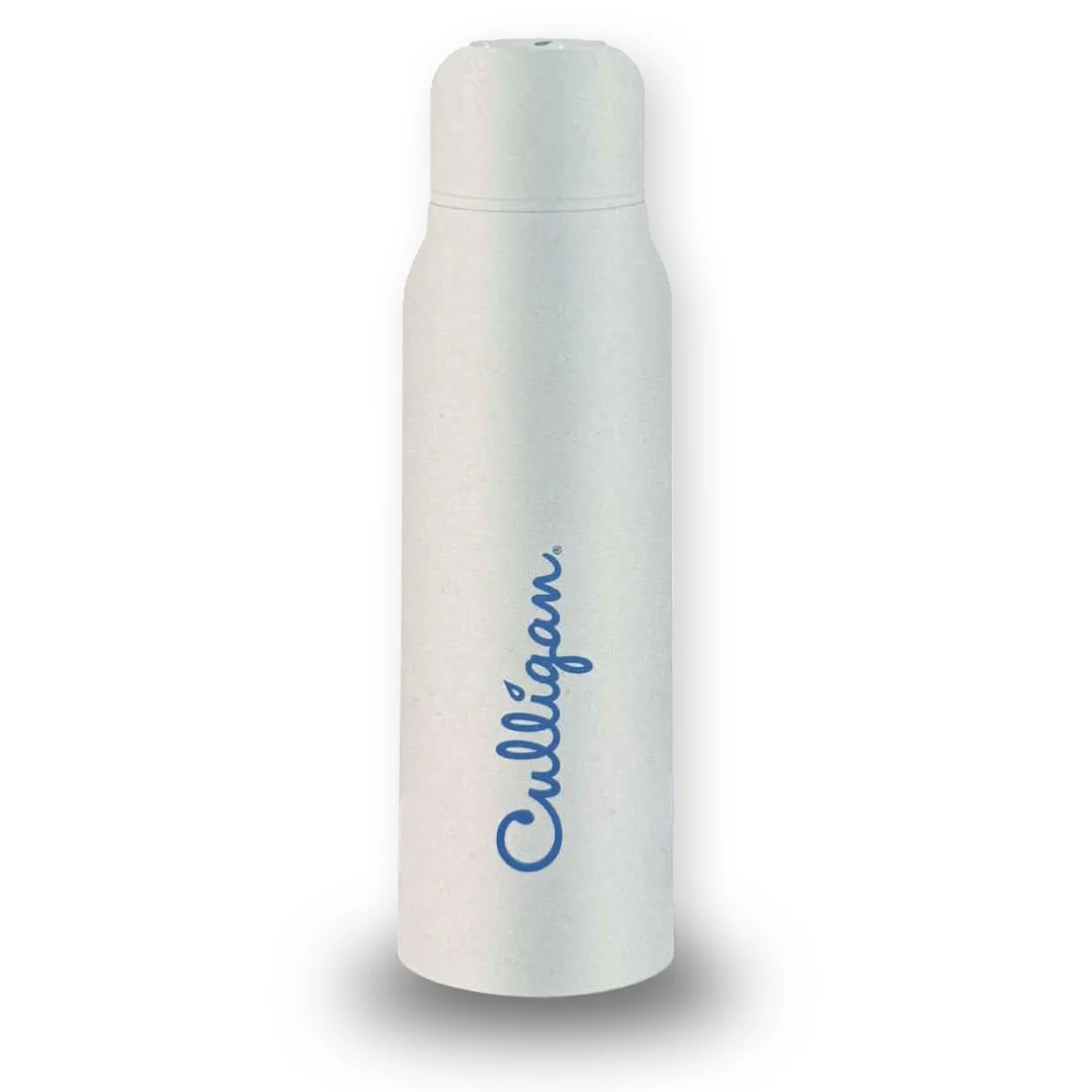
Treat your water with Culligan’s UVC LED water bottle. This easy to use, environmentally friendly bottle provides on-the-go water treatment, avoiding the use of added chemicals.
304 stainless steel double wall insulation for both hot + cold drinks
Manual activation + 6 hour auto-cycle mode
USB-C charging with long lasting battery
Eco-friendly, easy to clean, durable and long lasting
UV System Product Reviews
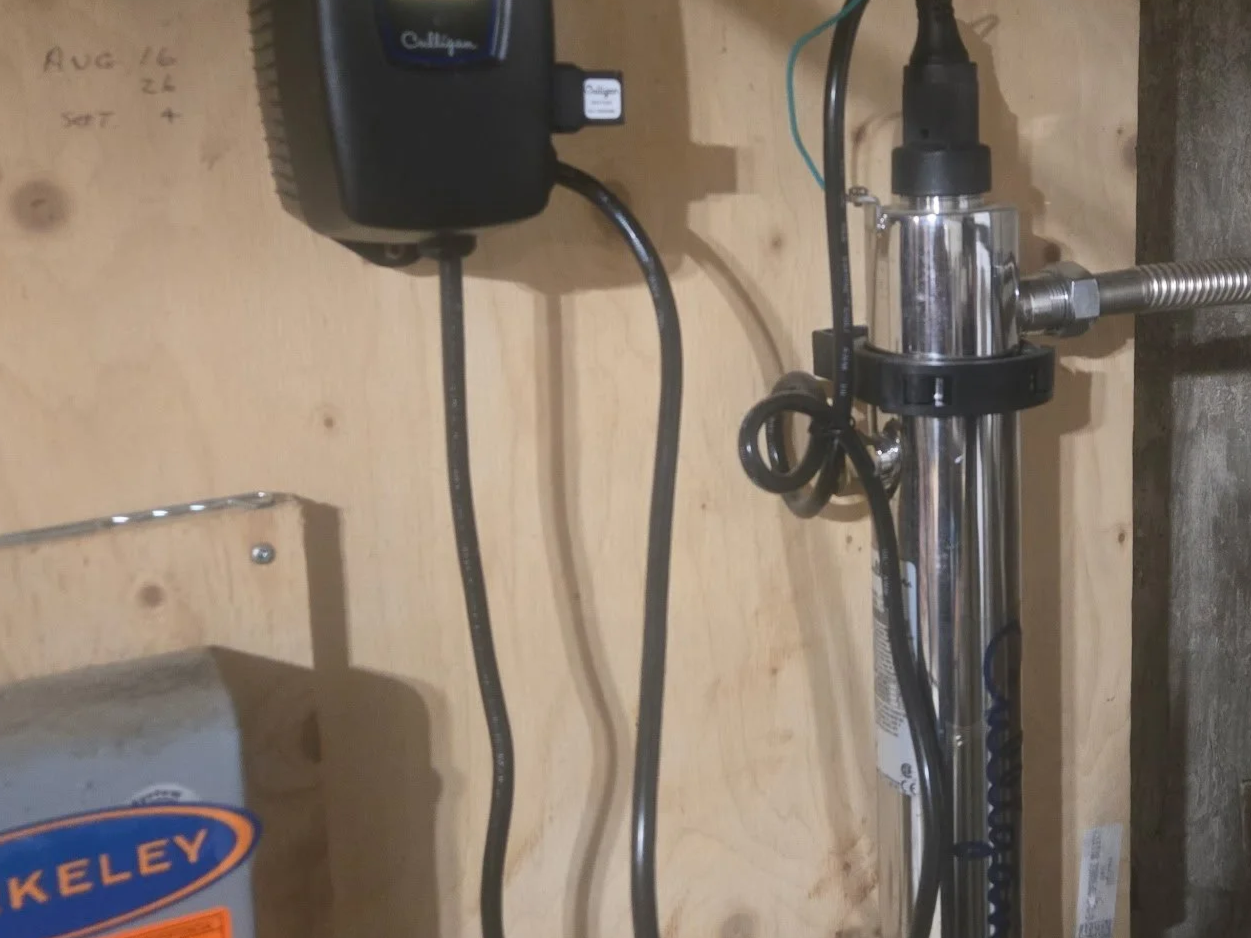
How does UV disinfection work?
UV is known to be an effective disinfectant due to its strong germicidal (inactivating) ability. As water runs through the UV reactor it is exposed to UV light that the lamp gives off, causing a genetic change in any microorganisms that are present in the water. In simple terms, when a microbe is directly exposed to the UV light, the DNA (its fundamental building block) of the cell is damaged thus preventing its reproduction. If a cell cannot reproduce, then the cell cannot cause infection.
UV System FAQs
-
Our full line of products are designed, engineered and assembled in Canada with the highest quality components. Our modern controller technology allows for flash field reprogramming. Our industry-first colour screen display provides detailed, versatile reporting and feedback on how your UV system is functioning. Our LightLock™ Lamp Key technology ensures only OEM parts are used, protecting your safety from products that say they are compatible but pose safety threats. We offer a wide variety of solutions for any disinfection application ranging from under-the-counter POU systems to industrial, 900 GPM+ installations.
-
When compared to other disinfection systems, the answer is no. As long as proper pre-treatment is maintained, an annual system check-up and lamp replacement is all that is required. As most UV systems are designed to be left on at all times, a typical household system will draw about the same energy requirements as a 40 watt light bulb
-
No, disinfection by UV is a physical process and not a chemical process. UV does not alter the water chemistry and will not affect the taste or odour of your water. UV only addresses microbiological concerns.
-
UV does have an effect on all microorganisms to some effect. Whether it is bacteria, viruses, algae, protozoan cysts, spores, mould, etc., exposure to UV light will harm the organism. Each individual organism requires a different level of exposure (know as UV Dose) in order to prevent cell replication. Some organisms, usually viruses, require extremely high doses of UV light in order to achieve disinfection. The important issue here is that one should ensure that the UV system they are purchasing delivers enough UV dose at the end of the lamp life to ensure adequate disinfection against a typical array of organisms found in drinking water.
-
The "right" UV dose is directly dependent on the application. Many industrial applications are pathogen specific but for the average home owner the target pathogens typically require low UV dosages to be eradicated. Currently, three different UV dose levels exist in the market; 16, 30 and 40 mJ/cm². The 16 mJ/cm² dose will eradicate typical waterborne pathogens. Industry standards have long suggested a UV dose of 30 mJ/cm² at the end of lamp life. This dose allows for nearly double the original US Public Health dose and allows for a comfortable safety margin. The most recent UV dose suggested is that of NSF International who suggests a UV dose of 40 mJ/cm².
-
There have been numerous instances around the globe where water has been provided by a municipality (or lake water approved by local board) that may not be safe. In these cases, the UV system installed in your home acts as "insurance" for your water supply; an inexpensive way to offer security to you and your family.
-
Yes, UV works extremely well at addressing the microbiological issues, but can be greatly impeded by the presence of other water issues. The main concerns for UV are that of water hardness, tannins, turbidity, iron, manganese and UV transmittance. All of these issues can be addressed by other water treatment equipment such as filters and water softeners.
-
To obtain replacement components for your UV system, you should contact the distributor you originally purchased the UV system from. They will be able to supply you with the part or order one for you.
-
The UV lamp should be disposed in accordance with your local regulations. The lamps should be disposed in the same fashion as any other fluorescent light fixture that may be in your home or office. Recycling is preferred.